
Can Coffee Be Too Fresh? Why We Rest Coffee After Roasting

Updated: Sep 20
Freshly roasted coffee must be better, right? Not necessarily. Here's why we normally let our espresso coffee rest before we start drinking it.
First, let's kill the “freshly roasted is best” myth
Somewhere along the way, specialty coffee managed to convince everyone that the fresher the coffee, the better the coffee.
And I understand why.
For years, a lot of people were buying coffee from supermarkets with no idea when it had been roasted. It could have been sitting in a warehouse, on a truck and then on a supermarket shelf for months.
So specialty coffee roasters started talking about roast dates and the importance of freshness.
That was a good thing.
But I think we've taken it a little too far.
We've gone from “don't buy stale coffee” to “coffee roasted yesterday must be better than coffee roasted two weeks ago.”
And those are not the same thing.
I've had customers look through bags trying to find the most recent roast date, or worry that coffee roasted ten days ago is somehow already getting old.
It isn't.
In fact, particularly for espresso, I'd probably choose the ten-day-old bag over the one roasted yesterday.
Freshly roasted does not automatically mean ready to drink.
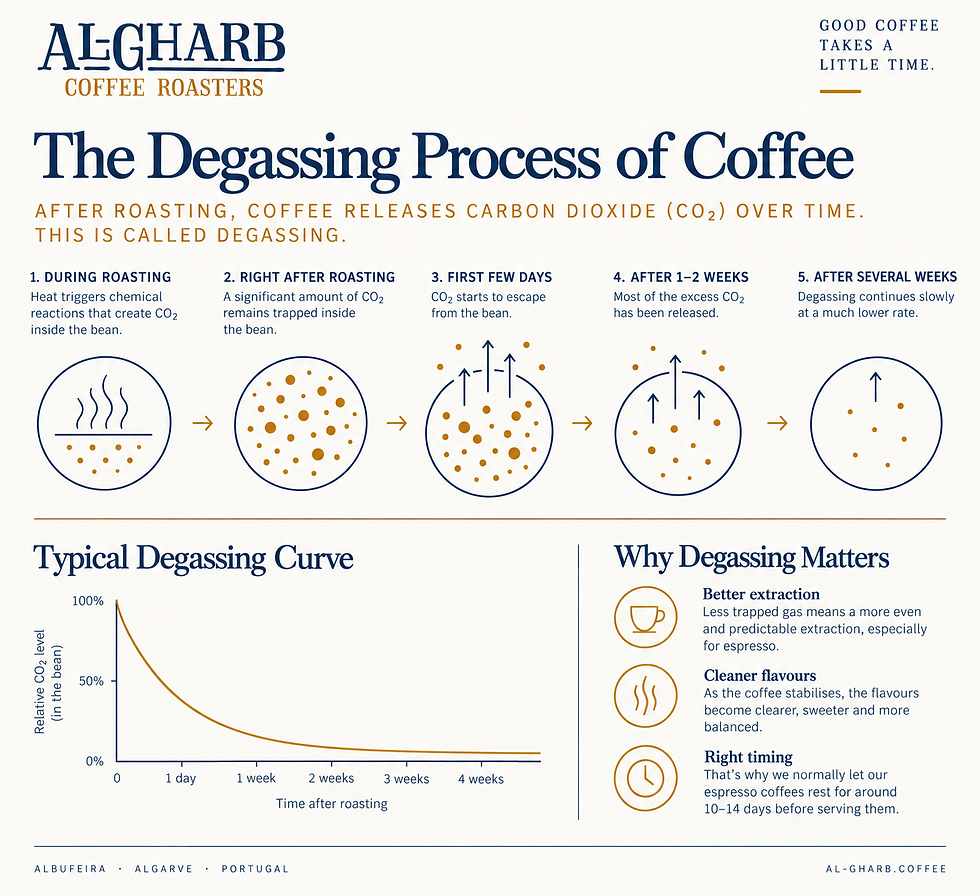
Coffee needs time after roasting. It needs to release CO₂, settle down and reach the point where it's easier to extract and, very often, simply tastes better.
That's one of the myths I'd really like us to dispel at Al-Gharb Coffee Roasters.
Don't chase the youngest possible roast date.
Look for properly roasted, properly rested, genuinely fresh coffee.
There's a big difference.
And to understand why, we need to look at what is actually happening inside the coffee after it leaves the roaster.
That is why I only give my baristas coffee that has rested for 14 days, and why customers love the coffee. The proof is in the final product.
☕ So what happens to coffee after roasting?
Roasting coffee causes a huge number of chemical reactions inside the bean.
The beans change colour, lose moisture, expand and become considerably more delicious.
They also produce gases.
A lot of that gas is carbon dioxide — CO₂.
Some escapes during roasting, but quite a lot remains trapped inside the coffee.
Once the coffee leaves the roaster, it slowly starts releasing that gas.
This is what we mean when we talk about degassing coffee.
And it doesn't happen instantly.
Why does CO₂ matter?
Because we're eventually going to introduce water to the coffee.
And water and escaping gas aren't particularly good friends.
When very fresh coffee comes into contact with water, the trapped CO₂ starts escaping rapidly.
You can see this particularly clearly when making filter coffee.
Pour water onto fresh grounds and you'll often see the coffee swell and bubble.
That's part of the reason we bloom coffee when making a V60.
With espresso, things become even more interesting.
We're trying to force water evenly through a tightly packed bed of coffee under pressure.
Lots of escaping gas can interfere with that process and make extraction less predictable.
The result can be an espresso that's difficult to dial in, unstable and not necessarily showing the coffee at its best.
Which is slightly frustrating when you've bought extremely fresh coffee specifically because you thought it would taste better.
So yes, coffee can actually be too fresh
This is the strange part.
If you buy coffee the day after we roast it, I wouldn't necessarily recommend rushing home and immediately trying to make the best espresso of your life.
Give it some time.
At Al-Gharb, I generally allow our espresso coffees to rest for around:
10–14 days after roasting.
For the coffee we use in the café, I'm normally closer to 14 days.
By then, much of the initial degassing has happened and I generally find the coffee considerably easier to work with.
The espresso becomes more predictable.
And, more importantly:
It tastes better.
Does every coffee need exactly 14 days?
Absolutely not.
Because that would make coffee far too easy.
Different coffees behave differently.
Roast level matters.
Bean density matters.
Processing matters.
How you're brewing it matters.
Even the way the coffee has been stored matters.
So when I say 10–14 days, I'm giving you a useful starting point for our espresso coffees.
I'm not announcing the Eleventh Commandment of Coffee.
Some coffees might taste fantastic after seven days.
Others might continue improving after two or three weeks.
Part of my job as a roaster is tasting the coffee and working out when it's ready.
Espresso and filter aren't quite the same
For espresso, I generally prefer a longer resting period.
Espresso is particularly sensitive because we're trying to extract coffee very quickly under pressure.
That's why our café espresso normally gets a good rest before it reaches the grinder.
For filter coffee, you can often start drinking it earlier.
The brewing method is more forgiving of the CO₂, and the bloom itself helps release some of the gas before the main extraction.
That doesn't mean your filter coffee is at its absolute best the day after roasting.
But you probably don't need to wait two weeks before touching it either.
And there's a very easy way to find out.
Try the coffee at different ages
This is something I'd encourage everyone to do.
Instead of obsessing about finding the perfect roast date, pay attention to how the coffee changes.
Try it at:
Day 3
Day 7
Day 14
Day 21
You might be surprised.
The coffee you thought was disappointing on day three might become sweeter, cleaner and considerably easier to brew a week later.
And once you've noticed this yourself, the idea that “fresher is always better” becomes much less convincing.
Why do coffee bags have that little valve?
Have you ever noticed the little plastic circle on a bag of specialty coffee?
That's a one-way valve.
It's there for exactly this reason.
Freshly roasted coffee is releasing CO₂.
The valve allows gas to escape from the bag without allowing lots of oxygen back inside.
Without it, freshly roasted coffee sealed into a bag could cause the bag to swell as the gas builds up.
So please don't squeeze the bag in the supermarket just because it smells nice.
You're forcing all those lovely aromas out through the valve.
Although I'll admit we've probably all done it.
Should I open the bag to let the coffee breathe?
No.
This is where degassing and staling can get confused.
We want CO₂ to leave the coffee.
We don't want lots of oxygen getting in.
Oxygen is one of the main things that causes roasted coffee to lose its freshness and flavour over time.
That's why our bags have one-way valves.
The coffee can release gas without you having to leave the bag sitting open on the kitchen counter.
Keep it sealed.
Keep it somewhere cool and dry.
And let the valve do its job.
Does coffee keep getting better forever?
Unfortunately not.
Resting and ageing aren't the same thing.
There is a period after roasting where the coffee is releasing gas and settling down.
Eventually, however, the balance starts going the other way.
Oxygen, heat, moisture and time gradually cause the coffee to lose aroma and flavour.
So we're looking for a sweet spot.
Not:
ROAST → DRINK IMMEDIATELY
And definitely not:
ROAST → FORGET IN CUPBOARD FOR SIX MONTHS → DISCOVER AGAIN
Somewhere in between.
My rule for fresh coffee
Don't become obsessed with having the freshest possible roast date.
I'd much rather you bought properly roasted coffee that's had enough time to rest than coffee roasted yesterday simply because the date looks impressive.
For our coffees, I'd generally start around:
Filter: try it after several days and see how it develops.
Espresso: give it roughly 10–14 days as a starting point.
Then taste.
Because the roast date can tell you how old your coffee is.
It can't tell you whether it tastes good.
Try this yourself
Next time you get a freshly roasted bag, don't wait until the “perfect” day.
Open it and experiment.
Make the same coffee at different stages.
Keep your recipe reasonably consistent.
Taste what happens.
You may find that the coffee becomes sweeter.
The acidity changes.
The aromas become clearer.
Your espresso becomes easier to dial in.
And somewhere along the way you'll probably discover the point where you like that particular coffee most.
Which is considerably more useful than me telling you there's one magical number that works for every coffee in the world.
Fresh coffee is good.
Properly rested fresh coffee can be even better.
— Henning Al-Gharb Coffee Roasters, Algarve
☕ Want to make better coffee at home?
Join The Friday Filter.
One useful coffee tip every Friday from the Al-Gharb Coffee Roasters.
Brewing advice, coffee experiments, things we've learned from roasting—and occasionally things we've learned by getting it completely wrong.
No coffee snobbery. Just better coffee.


_edited_edited.png)

Comments